Showing posts with label united states. Show all posts

Thursday, November 16, 2023

Pluto and Discrimination (Spoilers)


As November 16th of 2023 there has been a lot of buzz about Pluto, a manga created by Naoki Urasawa and with a series in Netflix there has been plenty of conversation about Pluto due the contemporary issues that border around discrimination, equity and equal rights that match the civil rights to a marginalized group which in-universe are robots to the Civil Rights movement or even Pride.

We need to think that is just a reinterpretation of The Greatest Robot on Earth arc that was in Astro Boy back in the 1960's and many other reinterpretations in the last five decades. Pluto is a complete juxtaposition of the original material, it's gritty and it has some essence that transcendent in to current world issues that are linked to discrimination and system race.

You as a viewer can see it on how the world deals with robots, is not that difficult to compare it to how systemic racism has pushed people of color down the rug in States with little to no development in the infrastructure of their people and how that lack of investment reflects in the culture and people life development. Is not difficult to see robots as a marginalized groups where their basic rights are constantly placed in danger.

Episode 1 and episode 5 have moments in which we can see how robots are threated, when they die they are handled as mere junk instead of acknowledging they are gone and there's no way to bring them back much as a person would be when they are declared dead, but even when they are gone there are comments by minor characters that their bodies are just junk which mimics a similar state when police and other public official mention when a transgender or genderqueer person is killed, the officials just mentions their lives were a mess and they got what they deserved.

The point that got my attention is within episode 5 which reveals how Gesicht  learned about rage and gained a motivation that made his AI to act beyond the robot laws and kill a human which was the brother of Adolf Haas who was murdering robot children. Similar situation goes with the general premise of the series which on some extent equals the gay panic defense which diminish the life of the people who were murdered.

Within the intricate narrative tapestry of Pluto, the exploration of discrimination goes beyond the realm of robotic rights and delves into the depths of racial inequality. The parallels drawn between the plight of robots and the systemic racism faced by people of color offer a poignant commentary on the shared struggles of marginalized communities.

The juxtaposition of how society deals with robots in the series mirrors the historical and ongoing challenges faced by communities of color, particularly in the United States. The narrative underscores the stark reality of systemic racism, where communities with little to no investment in their infrastructure find themselves pushed to the margins. The lack of development and support for these communities has a profound impact on culture and individual life trajectories, echoing the deeply entrenched racial disparities witnessed in society.

Episodes 1 and 5 provide crucial moments that amplify the social commentary. The dehumanizing treatment of robots when they meet their demise reflects a callousness akin to the dismissal of lives in marginalized communities. The dialogue surrounding robot "bodies" as mere junk echoes the troubling rhetoric employed by authorities when addressing the deaths of individuals from racial or ethnic minorities, perpetuating harmful stereotypes and reinforcing systemic biases.

In Episode 5, Gesicht's journey becomes a microcosm of the broader societal struggles against discrimination. His discovery of rage and his subsequent deviation from established robot laws to confront the human perpetrator draws an unsettling parallel to real-world scenarios where individuals, driven to the brink by systemic injustices, act outside established norms. This mirrors instances where marginalized communities, in the face of adversity, are compelled to challenge oppressive systems.

The series delves into the complexities of Gesicht's motivations, portraying the blurred lines between right and wrong, much like the gray areas that characterize discussions around racism and discrimination. The narrative prompts viewers to reflect on the cyclical nature of injustice and the repercussions of historical traumas, drawing connections to the deep-rooted struggles against racism that persist today.

Pluto's exploration of discrimination and racism extends beyond a mere reflection of societal issues; it serves as a compelling call to action. By weaving these themes into the narrative, the series challenges viewers to confront uncomfortable truths and actively engage in dismantling discriminatory systems. In doing so, Pluto transcends its robotic facade, emerging as a powerful and thought-provoking exploration of the interconnected struggles for racial and social justice in our contemporary world.

Wednesday, December 18, 2013

Mafalda and The Modern Critique to the Expansionist System of the First World

Mafalda Strip
Tampa, (Fl) --- Probably if you had lived your life in North America, you haven't heard about Mafalda; a comic strip that debuted on 1964 by the author Quino, which in the origins of the strip was a total different cartoon as it was a marketing strategy to sell products from the electronic company Mansfield in Argentina, which the company requested to the author, that the mascot should had the letter M in his/her name. That is a brief explanation on how the character was born, but it wasn't going to be until September, 29 of 1964 when the little girl would made her first appearance in the now defunct magazine Leoplon, who was under the tutelage of Quino's friend Miguel Brasco.

Almost, everything in the iconography of Mafalda offers a strong social critique about the problematic of the decade of the publication, yet still today (as the graphic on the top shows) there are some applicable about cultural identity, history and self-perception that can be used for today standards on how the younger generations are identifying themselves all due the globalization.

In a series of unrelated events, the idea of using children to express voices of discomfort is not new, one of the most memorable ones in the American culture were the creation of Bill Watterson "Calvin and Hobbes", were the use of critique was masked behind the shenanigans of a 6 year old and his pet tiger. The speech given in both comics is not very different, even with the eras and cultures there is always a similar pattern - discomfort through the system. -

Mafalda's conception comes from an era where the sexual revolution was on is apogee and Vietnam was an issue that affected the entire world; but, on a local level we have to analyze the political aspects that the Argentinian society was going through, such - as being an ally of the United States in the South African Border War, the fight between the fans of the soccer teams of Argentina vs. Peru that caused 315 fatalities, the space exploration and the influence of North America in the global culture - ; all those events and more, prompted the conception of Mafalda as a voice to critique the actions that molded the era, but overall to show the differences between the countries of the "north" vs. "the south ones" where the socio-economical struggles are discussed through the history of the strip.

The concept of the struggles between Norte y el Sur (sic. trans. North and South) goes on the concept of developed and underdeveloped countries, on how the countries went to the historical and economical points that they are. Maybe religion did influenced the development of the countries; as essentially North America is a country were Protestantism is the mainstream religion and in the south hemisphere, the Catholic Church is the body that executes influence.

It's a contradiction to think as the influence of religion could be subtle, depending on the sociopolitical location. Argentina itself is one of the countries where in matter of civil rights on the America's spectrum is years ahead of what is North America as a nation. Argentina, has itself problems related to the populism and the terrible legacy the Kirchner had left on an economical ground; yet, related to the LGTBQ rights, Argentina is "20 steps ahead" of North America.

Probably on a molding factor, the ideology of the Protestantism vs. Catholicism at the moment of fitting into the birth of a nation could had played a decisiveness in how the countries run on an administrative level, as well how people live their lives on their respective locations. The Catholic doctrine place humility and don't support the idea that the followers should enjoy their personal wealth, while Protestants go on the search of work as the path to find personal wealth and a collective well-being.

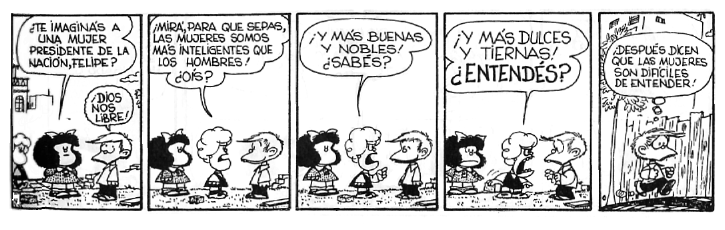
Mafalda herself borders on the line of feminism and a radicalism that shows a reality that had been lived through many generations; the lack of female dominance because of the archaic matrilineal ideals that support patriarchy and put the woman on a second plane, beside that she goes on an intellectual level  where she exposes a problem - Runaway brains- the phenomenon where intellectuals as well educated leave the country due lack of prosperity, and, the inversion of the State into education and improvement became null.

Probably that is the reason why Latin America in terms of a technological level is so far away, because there is no future and the different perspective to achieve a boom with technology as well to improve the financial reality are scarce. Not even thinking that making a decision based on the gender could create a difference, as it doesn't matter if there is no education, take a look at the case of Argentina where Mafalda comes from and the current dignitary has achieved almost nothing.

Wednesday, October 31, 2012

The Problematic of Panhandling in Tampa: No Real Solutions a Year Later

Tampa, Fl -- It's been a year since the war on panhandling was supposedly won, but the real solution on a problematic that affects third world countries as well big cities on the United States is far away from over. The problematic of panhandling is relatively new in the United States not being old since the days of Vietnam but over the years the problematic has grown so far that he BLS don't really have a concrete analysis on how much the phenomenon has grown over the last 5 decades.

The problem in Tampa lays that the city hall vainglory that the problem has been controlled but the beggars are still there on the mayor intersections in the city such as Hillsborough and Dale Mabry, around all Busch Boulevard or across 60th, on 10/30/2012 marked the year anniversary ban on Tampa's panhandlers but in a parallel  case that happened in Colombia over the course of the years you can't put the panhandlers out of the streets permanent unless the congress create a solution for the deficit in the job market.

According to the Tampa Tribune, Tampa's Mayor Bob Buckhorn said "Our medians had turned into the equivalent of Gilligans Island."  but Lesa Weikel a spokeswoman for the Homeless Coalition of Hillborough County expressed  that the ban was only to put the homeless away from the public sight and out of mind by removing them from the streets. A 2011 survey in Hillsborough County counted nearly 18.000 people who fit the expanded definition of homeless, meaning many were crashing at friend's or relatives homes, even cheap hotels but the American definition or icon of being homeless juxtapose what is being homeless in a third world country where being homeless is having no help at all from the government and trying to live the day by day as you can.

The evolution of being homeless has changed dramatically over the last 5 decades, social advocates say, with high unemployment and a steady pace of foreclosures have put people on the streets who shouldn't been there; yet the panorama of the United States regard being homeless in other part of the continent is vastly different as citizens aren't use to see beggars around middle class towns or in the suburbs; in Colombia was extremely common to see beggars and children begging for food and money on almost every corner, generations grew with the idea of watching people in the streets to the point individuals had become distant regarding other individual realities.

One solution in Tampa to aid the homeless came in the hands of the late publisher and activist Bill Sharpe whose work is well known through the city, as he founded the EPOCH newspaper as a resource to help the people in need on the only day panhandling is not prohibited which is Sunday but finding a real solution to a problematic that has generated a lot of social issues in other parts of the world is far away from being over.

Thursday, May 17, 2012

Where is the Freedom, Justice, Hope, Equality and Prosperity for All?

Freedom is not free, that's a fact, but argument that war is an option, the only option there you have something wrong in your life; We are all equal, but if you are not a white, Christian, straight, man then you are not equal, that's equality, only for a few but not for the majority; if you are a woman, still in many places thinking about prosperity if you are independent is not an option because there is not a man behind you to tell you that woman are not independent and according to our grandparents and the dogma, woman are to serve the man, again, wrong, still in this century, more than a thousand years, more than 4 millennium where humans rise we still think that men are the only ones who are the ruler of the world, or as it was say in All About my Mother between the conversation of Manuela and Sister Maria Rosa; "Women will do anything to avoid being alone" "Women are more tolerant, but that's good." when they were discussing about men. Justice, sounds more of a superhero name rather than an actual right, there is no justice, there is rarely justice because every day, basic rights are violated but yet there is still hope. For some weird reason, Hope never dies.


I've been wondering, if it's OK to interpose a religious regime?, if it's OK to put on a side the democracy, the main principles on what this country it's based. It's not OK to violate the idea that we are multicultural/ heterogeneous nation and yet the idea that everyone should be again on the 1950's ideal where everyone is white, straight, Christian and if you are a woman your voice is only on the kitchen and if you are black or any other minority you should be as a maid or servant is being present on the G.O.P. ideals where the common majority don't show a respect of any human beings if they don't fit on the ideals of what America should be. As a Hispanic I am not putting my vote on Romney, or any other politician that represent what he represent. A corruption in a political party, yet Michael Bloomberg and Rudy Giuliani showed a different face of the G.O.P. way too different of the one showed by the loonatics as Romney, Bachmann and Santorum.

We as a country we have evolved way too much, yet we are seeking a regression, it could a political trend if we analyze the international politics around the continent where more populist and charismatic leaders are taking control of different nations with the same promise of going back to the basics but instead the destroy every process of democracy and civil rights. Are we as people o retrograde to see beyond our little bubbles?. Probably, maybe we are but also we are a frightful and primitive species where we as masses we can be manipulated to think beyond the progress we had made as a collective because we would like to live in an ideal utopia and there is no such thing, we can get all these values if we work toward the prosperity we deserve and not different factions that live under the same soil.