Showing posts with label Mafalda. Show all posts

Saturday, September 2, 2017

Mafalda Short Essay

10 Years with Mafalda
(8/31/2017) --- It's been ten years since I had the chance to put my hands in a Mafalda (1) book, better say to see it in person.  To give a brief idea of who is Mafalda and what is her universe? It's the comic strip of an Argentinian girl who was created by Quino (2) in 1964. We need to understand that Mafalda started as an advertisement oriented cartoon and it evolved to be a product of is time.

Beyond the socio-political setting of the 1960's in which each character represents different ideological aspects of the Argentinian culture, the setting can be still applied in the contemporary of today's social panorama in which the rise of populist and neo-nazi parties are creating an urgency in which a new voice such as Quino and thus Mafalda need to be hear. 

Of course we have Doonesbury (3) but over the years Gary Trudeau (4) has lowered the pace of the strip because of age and other commitments, leaving an opening for young cartoonists who have this disposition of media beyond any printed means to reach their desired targeted audience.

What I found interesting, is that Mafalda never struck openly in the United States; it could be due sociological differences; humor disparity or the way the people see society's evolution and how international and regional relations evolve on a daily basis. It is important to have some form of political humor and critique that can reach to the people of every country and make them think about how to change and impact their communities.

On the United States a cartoon as Mafalda is just scarce, there aren't many on mainstream media besides Doonesbury and is actually quite sad, because there aren't any new voices that can impact the readers; I guess, there is always online media and hosting, albeit is difficult to reach an audience without the proper funds.

I haven't found any official translations about Mafalda at least in Tampa, I know online there are some unofficial's, but nothing in particular. Why we need a character as Mafalda? Or at least to read it beyond the language and cultural barriers, because it expose a strong female character who is non-conformist with the rules of the society that she is growing up.

We as readers, we need to understand that the comics expose a great deal of feminist and existentialist tones that transcend the bounds of 1960's in Argentina; it sets a series of examples that we can be whatever who we want to be and hesitate and question our surroundings. It gives an amazing introduction to younger readers about what is to be a female and to try to expose your ideas as openly as possible; knowing that within gender bias there would be a difficulty to expose your ideas.

On an existentialist level, Mafalda is just a prime example towards how the following a retrospective and exo analyses could lead to see solutions on a problematic social enviroment, but also to understand the part of yourself that makes it your own persona; the idea of an existential doubt shouldn't be seen as a bad "thing" as is part of a composed ego and well structured critical thinking.


Reference:

  1. https://en.wikipedia.org/wiki/Mafalda
  2. https://en.wikipedia.org/wiki/Quino
  3. https://en.wikipedia.org/wiki/Doonesbury
  4. https://en.wikipedia.org/wiki/Garry_Trudeau

Wednesday, December 18, 2013

Mafalda and The Modern Critique to the Expansionist System of the First World

Mafalda Strip
Tampa, (Fl) --- Probably if you had lived your life in North America, you haven't heard about Mafalda; a comic strip that debuted on 1964 by the author Quino, which in the origins of the strip was a total different cartoon as it was a marketing strategy to sell products from the electronic company Mansfield in Argentina, which the company requested to the author, that the mascot should had the letter M in his/her name. That is a brief explanation on how the character was born, but it wasn't going to be until September, 29 of 1964 when the little girl would made her first appearance in the now defunct magazine Leoplon, who was under the tutelage of Quino's friend Miguel Brasco.

Almost, everything in the iconography of Mafalda offers a strong social critique about the problematic of the decade of the publication, yet still today (as the graphic on the top shows) there are some applicable about cultural identity, history and self-perception that can be used for today standards on how the younger generations are identifying themselves all due the globalization.

In a series of unrelated events, the idea of using children to express voices of discomfort is not new, one of the most memorable ones in the American culture were the creation of Bill Watterson "Calvin and Hobbes", were the use of critique was masked behind the shenanigans of a 6 year old and his pet tiger. The speech given in both comics is not very different, even with the eras and cultures there is always a similar pattern - discomfort through the system. -

Mafalda's conception comes from an era where the sexual revolution was on is apogee and Vietnam was an issue that affected the entire world; but, on a local level we have to analyze the political aspects that the Argentinian society was going through, such - as being an ally of the United States in the South African Border War, the fight between the fans of the soccer teams of Argentina vs. Peru that caused 315 fatalities, the space exploration and the influence of North America in the global culture - ; all those events and more, prompted the conception of Mafalda as a voice to critique the actions that molded the era, but overall to show the differences between the countries of the "north" vs. "the south ones" where the socio-economical struggles are discussed through the history of the strip.

The concept of the struggles between Norte y el Sur (sic. trans. North and South) goes on the concept of developed and underdeveloped countries, on how the countries went to the historical and economical points that they are. Maybe religion did influenced the development of the countries; as essentially North America is a country were Protestantism is the mainstream religion and in the south hemisphere, the Catholic Church is the body that executes influence.

It's a contradiction to think as the influence of religion could be subtle, depending on the sociopolitical location. Argentina itself is one of the countries where in matter of civil rights on the America's spectrum is years ahead of what is North America as a nation. Argentina, has itself problems related to the populism and the terrible legacy the Kirchner had left on an economical ground; yet, related to the LGTBQ rights, Argentina is "20 steps ahead" of North America.

Probably on a molding factor, the ideology of the Protestantism vs. Catholicism at the moment of fitting into the birth of a nation could had played a decisiveness in how the countries run on an administrative level, as well how people live their lives on their respective locations. The Catholic doctrine place humility and don't support the idea that the followers should enjoy their personal wealth, while Protestants go on the search of work as the path to find personal wealth and a collective well-being.

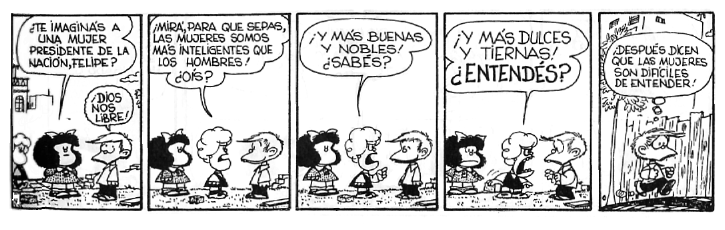
Mafalda herself borders on the line of feminism and a radicalism that shows a reality that had been lived through many generations; the lack of female dominance because of the archaic matrilineal ideals that support patriarchy and put the woman on a second plane, beside that she goes on an intellectual level  where she exposes a problem - Runaway brains- the phenomenon where intellectuals as well educated leave the country due lack of prosperity, and, the inversion of the State into education and improvement became null.

Probably that is the reason why Latin America in terms of a technological level is so far away, because there is no future and the different perspective to achieve a boom with technology as well to improve the financial reality are scarce. Not even thinking that making a decision based on the gender could create a difference, as it doesn't matter if there is no education, take a look at the case of Argentina where Mafalda comes from and the current dignitary has achieved almost nothing.